
Stair Chair Solutions for Emergency Evacuation
CAN YOU EVACUATE YOUR VISITORS AND STAFF SAFELY?
In the United States, evacuation chairs are often referred to as stair chairs because they are designed to help move people safely on stairways when elevators cannot be used. Evac+Chair provides trusted stair chair solutions for emergency evacuation in offices, schools, hospitals, senior living communities, public buildings, and multi-story facilities.
When an emergency occurs in a multi-storey building, elevators are often unavailable, leaving stairways as the primary means of escape. For individuals with reduced mobility, injuries, disabilities, or temporary impairments, navigating stairs independently may be impossible. This is where a stair chair becomes an essential part of a building’s emergency preparedness strategy.
In the United States, the term “stair chair” is widely used to describe equipment designed to move individuals safely on stairways. Depending on the application, stair chairs may be used by emergency medical services, hospitals, senior living communities, schools, commercial buildings, and public facilities. In emergency preparedness and life safety environments, evacuation chairs are often referred to as stair chairs because they perform the same critical function – enabling safe movement on stairs when elevators cannot be used.
This guide explains what stair chairs are, how they work, who needs them, and how to select the right solution for your facility.
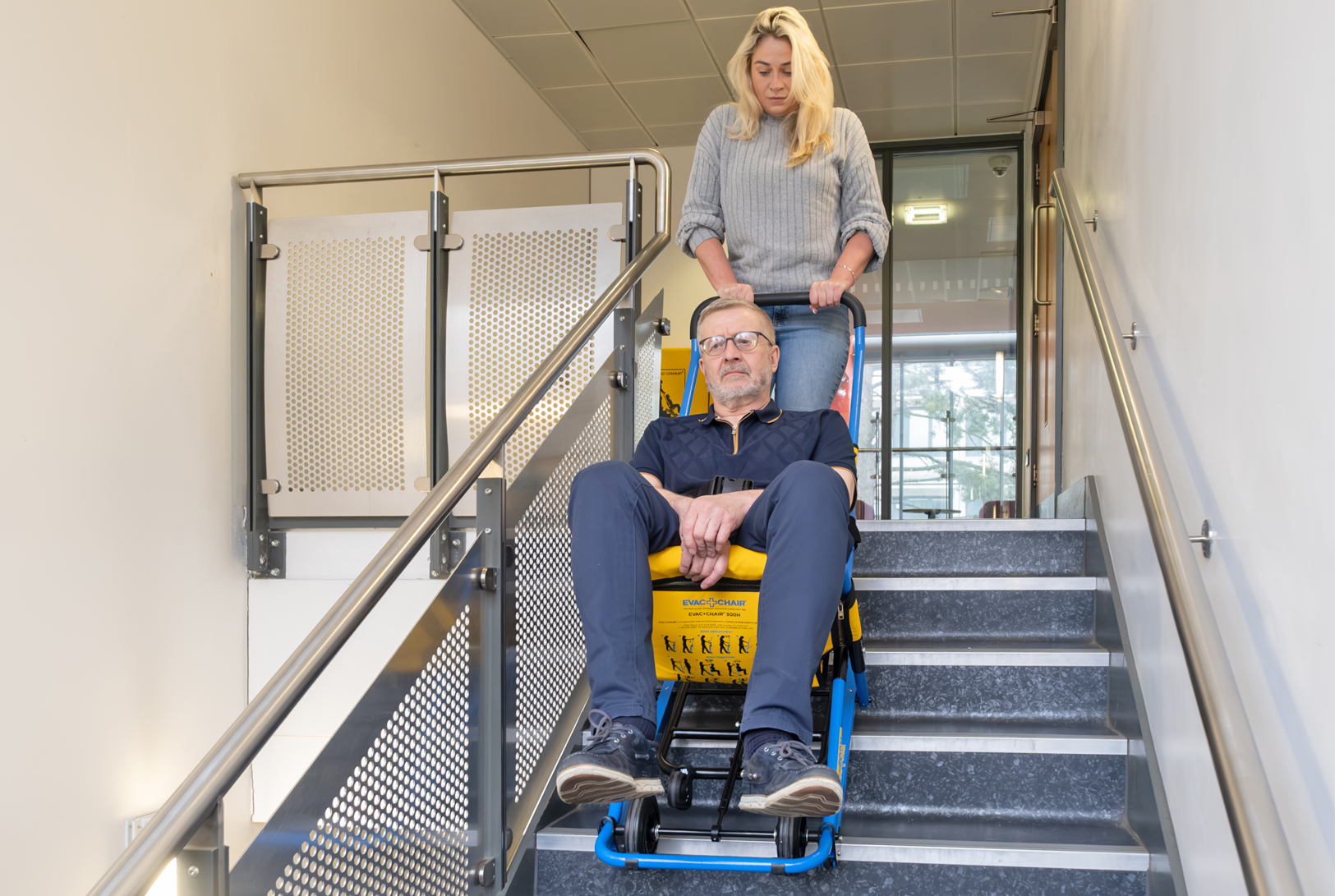
What is a Stair Chair?
A stair chair is a specialized mobility device designed to safely transport an individual up or down stairs. Unlike wheelchairs, which are intended for level surfaces, stair chairs incorporate tracks, braking systems, or powered mechanisms that allow controlled movement on stairways.
Stair chairs are commonly used in:
Office buildings
Hospitals and healthcare facilities
Senior living communities
Nursing homes
Schools and universities
Airports and transportation hubs
Hotels and hospitality venues
Government buildings
Emergency response services
Their primary purpose is to help protect occupants who cannot safely descend or ascend stairs during an emergency or planned movement between floors.
Why Stair Chairs Are Essential During Emergencies
During fires, power outages, severe weather events, earthquakes, and other emergencies, elevators are frequently taken out of service. Individuals who rely on wheelchairs, walking aids, or caregiver assistance can become trapped on upper floors if suitable evacuation equipment is unavailable.
A properly deployed stair chair helps:
Improve emergency preparedness
Support mobility-impaired occupants
Reduce manual lifting risks for operators
Enable faster evacuation times
Enhance building accessibility planning
Strengthen emergency response procedures
Support personal emergency evacuation plans (PEEPs)
For many organizations, stair chairs are no longer viewed as optional equipment but as a critical component of a comprehensive life safety strategy.
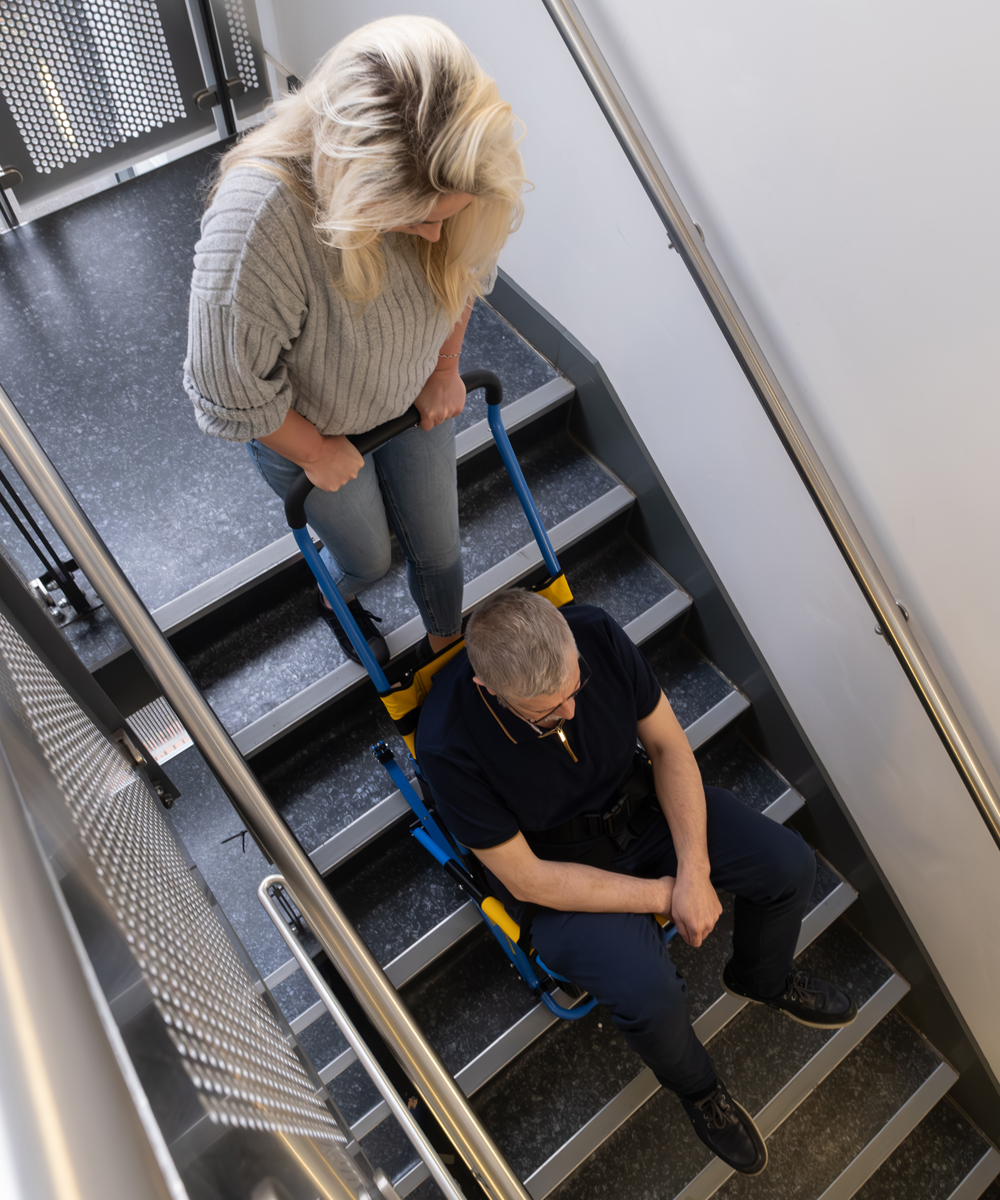
Types of Stair Chairs
Manual Stair Chairs
Manual stair chairs utilize specially designed friction tracks or controlled descent systems to assist operators when moving individuals downstairs.
Benefits include:
Lower acquisition costs
Minimal maintenance requirements
Reliable operation without batteries
Lightweight construction
Simple deployment
Powered Stair Chairs
Powered stair chairs use battery-operated motors to assist with stair ascent and descent.
Benefits include:
Reduced physical effort
Improved operator comfort
Enhanced control
Suitable for heavier occupants
Effective in facilities with multiple floors
EMS Stair Chairs
Emergency medical service stair chairs are specifically designed for patient transport by first responders and ambulance crews.
These often prioritize:
Compact storage, Rapid deployment, Patient restraint systems and Lightweight transport capability.

Choosing the Right Stair Chair
Selecting the right stair chair involves more than simply comparing specifications. Every building presents unique challenges, and the most suitable solution will depend on the environment in which it will be used, the occupants it is intended to support and the organization’s overall emergency preparedness strategy.
One of the first considerations should be the layout of the building itself. Staircase width, landing sizes, floor count, and the presence of tight turns can all influence which type of stair chair will perform most effectively. Facilities with multiple floors or complex stairwells may benefit from powered stair chair solutions that reduce physical effort for operators while providing greater control during ascent and descent.
The needs of the individuals who may require evacuation should also play a significant role in the decision-making process. Healthcare facilities, senior living communities, schools, and commercial buildings often support people with varying levels of mobility, meaning a stair chair must be capable of accommodating different user requirements comfortably and safely. Weight capacity, occupant support, ease of transfer, and overall stability should all be carefully assessed.
Staffing levels and available resources are equally important. Some organizations may have dedicated emergency response teams, while others rely on a smaller number of trained personnel during an incident. In these situations, selecting a stair chair that can be deployed quickly and operated with minimal physical strain can significantly improve evacuation efficiency and operator confidence.
A stair chair should be viewed as part of a broader emergency evacuation plan rather than a standalone purchase. The most effective solutions work best with existing emergency procedures, accessibility policies, staff training programmes, and personal emergency evacuation plans (PEEPs). By considering both operational requirements and long-term preparedness objectives, you can select a stair chair that not only meets today’s needs but continues to support occupant safety for years to come.
For any questions, we are happy to have one of our experts assist you.
EMS Industry Insights
Why Stair Chairs Remain Essential for EMS Crews

EVAC+CHAIR® North America, LLC, maker of the original, lightest and worlds best selling Evacuation Chair, announced the supply of their Evacuation Stair Chairs to the world famous St Jude Research Children’s hospital.
Across the United States, EMS teams continue to face increasing demand for patient movement in environments where stretchers cannot be safely deployed. Narrow stairwells, apartment buildings, multi-storey homes, and older commercial properties often require first responders to rely on stair chairs to safely move patients while reducing lifting strain and improving crew safety.
As emergency services focus on reducing musculoskeletal injuries among first responders, modern stair chair designs have evolved to include enhanced track systems, powered assistance, improved restraint systems, and higher weight capacities. These developments help EMS agencies improve patient handling procedures while supporting safer operations in challenging environments.
For healthcare facilities, senior living communities, and public buildings, the same principles apply. Having dedicated stair chair equipment available can help bridge the gap between emergency responders arriving on scene and the safe evacuation or movement of individuals who cannot independently use stairs.
DOWNLOAD OUR COMPLETE GUIDE TO EVACUATING HEALTHCARE FACILITIES
Includes advice on:-
PLANNING CONSIDERATIONS
EVACUATION STRATEGIES
EVACUATION PLANS (GEEPS/PEEPS)
EVACUATION EQUIPMENT
PLUS AN EVACUATION CHECKLIST

